
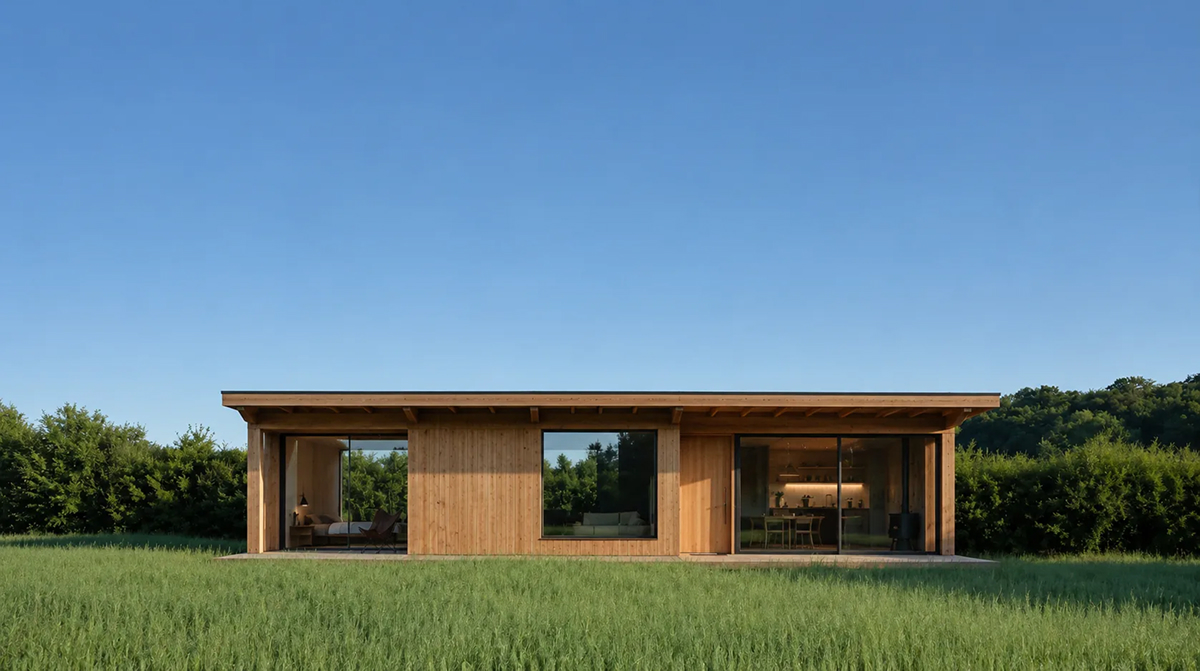
Offsite construction is not simply a conventional build moved indoors. At its best, it is a more coordinated way to design, resolve, manufacture, deliver, and install a complete home.
The familiar building process often unfolds one decision at a time on site. Details can remain open until late, different trades interpret information at different moments, and the programme is exposed to weather and changing conditions.
A factory-built home asks more questions earlier. Architecture, engineering, services, finishes, transport, installation, and site work need to be coordinated before manufacture. That front-loaded thinking is what creates clarity later.
Design comes first
Prefab should not mean generic. It means creating a well-resolved architectural system that can be made consistently and adapted intelligently to real sites.
Orientation, daylight, privacy, movement, storage, and the relationship between rooms still determine whether a home is enjoyable to live in. The difference is that these decisions are tested against manufacturing, transport, energy performance, and installation requirements from the beginning.
That integration prevents the design from being passed between disconnected stages. The home is developed as one coordinated object, with fewer opportunities for important details to be lost between drawing and construction.
Factory-built should describe where the home is made—not how the home feels.
A controlled place to build
Manufacturing indoors creates a stable environment for materials, people, and quality checks. Work is less exposed to rain, extreme heat, mud, and repeated delays caused by changing weather.
It also supports a repeatable sequence. Components arrive where they are needed, tools and specialist teams remain close by, and inspections can occur at defined milestones. Repetition does not remove craftsmanship; it gives skilled work a better setting.
Less material movement
A central facility can manage deliveries and offcuts more deliberately than a dispersed site. Accurate ordering and repeatable detailing help reduce avoidable waste.
Quality that can be checked
Elements that will later be concealed can be reviewed during manufacture. The aim is not perfection by promise, but a process that makes quality visible and accountable.
The site can move in parallel
Once approvals and technical information are in place, the home can be manufactured while suitable site preparation progresses. Foundations, service connections, access planning, and delivery coordination do not always need to wait for the entire building to be constructed in sequence on the land.
This overlap is one of the reasons an offsite programme can be shorter. It must still account for planning, design development, engineering, approvals, site investigation, procurement, and transport. “Built in weeks” describes factory manufacture—not permission to skip the work required before it.
A credible programme separates design and approvals, factory manufacture, site preparation, delivery, installation, connection, and handover. Each stage should have clear dependencies.
Clarity before speed
Speed matters, but certainty matters more. A fast factory programme only helps when the right home, site solution, specification, responsibilities, and costs have been resolved first.
A coordinated offsite process should give you:
- A defined home model and documented specification
- A clear distinction between the home package and site-specific work
- Early review of planning, access, foundations, connections, transport, and cranage
- A connected programme from design through installation
- Named responsibilities and decision points before manufacture
Is offsite right for every block?
No building method is right for every site. Difficult access, overhead obstructions, steep terrain, unusual planning controls, bushfire requirements, flood conditions, or highly specific design ambitions can influence what is practical.
The answer is not to force a standard home onto unsuitable land. It is to review the constraints early and decide whether the model, delivery method, and project budget make sense together. The earlier that decision is made, the more useful the offsite process becomes.